Maximizing Moments

by Kelly O’Connell Honn

With nearly 28 years of classroom experience, Kelly O’Connell Honn shares how she maximizes teachable moments on the fly with her 5th Grade ELA students at Hawthorn Hill Elementary School in the Lee’s Summit School District. Not only is Kelly an extraordinary educator, she is my amazing sister-in-law, mentor, and friend!

Every teacher has been told they need to be flexible. Fire drills, tornado drills, safety drills, assemblies, phone calls, meetings, band aids, and students being called out of class are a few of the daily reasons to be flexible. What we don’t talk enough about is when, in the middle of a well-planned lesson, a student asks a question or makes a comment that should take that lesson in a whole new direction. Those are some of my favorite moments! 

We all feel pressure to teach the given curriculum and all those standards. What we do with that curriculum is how we as teachers can provide our students with exactly what they need. While we all have plans for how our day will go, the best days are when that idea pops into our minds in the moment of how it can be better than anything we planned. 

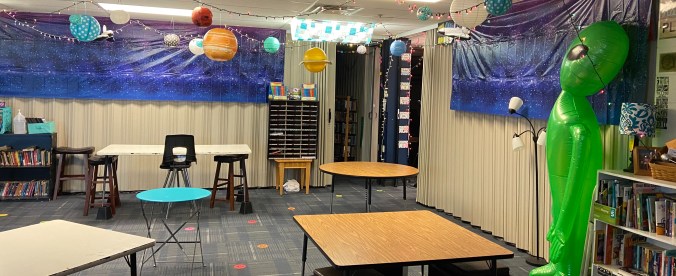
A teachable moment can be something as small as a student saying, “I wish we could just snuggle up and read a book since it’s raining this morning,” and going along with that to show students that their voice matters. Current events can spur a teachable moment that will be sure to increase student engagement.  As we were in the midst of our space unit last year, my students were talking in a group about how cool it would be to talk to an astronaut. Hearing this spurred me into trying to figure out how we could do this. In sharing my dilemma with my principal, he stated that there was a professor he knew who was a former astronaut. I was able to contact her and she met with us on a Zoom meeting. The kids were mesmerized by what she had to say, and at the end of the year it was a highlight that they reflected on often.

Kids ask questions. So many questions. Why? They are curious! What more can we ask for? Kids who are curious want to learn. I try to let those questions be the teachable moments they are meant to be. I am fortunate enough to teach where every student has their own device, therefore the world is at their fingertips. When a student asks a question, I encourage them to find the answer. If it is a big question, we search for answers as a class. Some people may say that takes too much time and they won’t get their curriculum taught. I say you will teach so much more! When these moments happen, the kids are learning how to work together to find answers, they are using research and reading skills, and they are solving their own problems. 

It is wonderful when teachable moments just authentically happen, but sometimes we also need to create those moments. We can do this when we truly know our students and what they want to know. Instead of dreading the latest trend on TikTok or YouTube, use it! If all the kids are obsessed with something like the ‘Simple Dimple’, think about ways you can use it in their learning. Who invented it? What are other fidgets that kids like to use? Why were they created in the first place? When bottle flipping was all the rage, we did a science experiment with it and the kids wrote a report about their findings. These are the ways we can connect with our students and keep them engaged at high levels. 

One of my favorite teachable moments was when I was looking to purchase a new car. Of course, I shared this with my students. Out of the kindness of their hearts, they offered to help me decide what kind of car I should buy. Since I was so undecided, I took them up on their offer. This turned into a project where the kids were researching vehicles and their available options, safety ratings, reviews, and prices. Not only were they having fun and using numerous ELA skills, but they were also working on a real world problem. When they finished, they created presentations to convince me of which vehicle I should purchase. 

There are moments in each day that enable us to capitalize on the curiosity and excitement of the learners in our room. It is up to us whether or not we take advantage of those opportunities. When we do, we never know how far our students will go with them.
Maintaining a Positive Digital Reputation (for Educators)

As educators, we must work to diligently safeguard our reputations. Within this increasingly digital age, educators now need to vigilantly monitor and maintain their digital reputations as well. Here are some quick tips to help you do you…

This list is presented in no particular order and is by no means intended to be an exhaustive list. I welcome any constructive suggestions you may have…perhaps I’ll add or incorporate your idea! Stay tuned…

Take personal responsibility for your actions.

I often say, “Don’t do dumb stuff, but when you do, own it!” This is an all-encompassing tip for life, but certainly applies with respect to use/misuse of technology. Everyone makes poor choices and/or a mistake at some point or another. Recognize when it happens to you. Own that this was your choice or mistake. Admit to yourself (and others, if necessary) that it happened. Work to make it right (i.e., find a workable solution, admit wrong doing, apologize, make restitution).

Keep work life and private life separate.

Yes, some of your colleagues become personal friends and may correspond with you outside of work…that is fine. Ensure that such relationships do not cross boundaries and devolve into the “unprofessional” (e.g., disparaging talk about others, gossip, compromising photos/videos, ethical missteps, confidentiality issues). If necessary, have separate social media accounts designated for your professional and your personal lives. Maintain privacy settings accordingly. Ensure that your private social media is “locked tight” so that only friends and family can view and read your postings. 

Don’t communicate or post photos or stories about students, staff members, or the workplace using personal digital technology without written consent.

Follow district policies regarding communication about students. Follow district’s policies regarding difficult situations that occur among staff members and/or in the workplace.

Ask yourself, “Is it worth posting?”

Follow the Golden Rule (i.e, “If you can’t say something nice, don’t say anything at all.”) when writing or posting anything. Think about whether you would want someone to post this about you. 

Don’t correspond with students!

Even after students graduate, use discretion. This protects you as much as it protects them. In addition, it further separates your professional and private lives in healthy ways.

Consider how your post may be interpreted (or misinterpreted). 

Keep comments that can be misconstrued off your social media. Especially be careful when posting about religion, social issues, politics, social events (e.g., photos with alcohol in them), and hot-button topics. Yes, this is “not fair,” but as an educator, you are a “public figure” within your school community. What you say/write/post can reflect positively and negatively on you, your school, and your district despite the best of intentions.

Do not leave personal devices (e.g., cell phones, laptops, iPads) unattended or unlocked.

Since you cannot control what others send to you, you need to maintain control over your devices so that someone does not “accidentally” view a posting or message that causes them to be upset or causes you unnecessary struggles. Doing this helps to protect your personal data, too.

Only use district approved apps and sites; preview YouTube videos, other online videos, and/or websites to be used in class; follow the district technology agreement regarding policies of use.

This protects both you and your students from unsafe online situations that may land someone on an inappropriate or compromising website. If you “need” to access a site that is not preapproved, request permission from you district’s tech department; if deemed appropriate, the site can be unlocked. 

Communicate professionally and appropriately. (NOTE: Texts are discoverable in legal proceedings and fairly easy to recover.)

As in all interactions, maintain professionalism in all situations. When in doubt, have someone else proofread your correspondence before sending it to verify that you are properly and effectively communicating and that the words cannot be misinterpreted or your intent be misrepresented.

Make sure you understand which students can be photographed and which cannot (student privacy).

Maintaining student privacy and respecting parents’ wishes is paramount. This builds trust…and prevents possible lawsuits. 

Protect student safety and privacy first and foremost!

As educators, student safety is paramount. Provide students with effective guidelines and monitoring when they are working online. Give them the training and tools they need to learn how to work safely within an online environment.

Seneca and the Oxford Comma

For the first time in more than 25 years, I spent time with a man whom I truly respect and admire…my college advisor, Dr. Don Ranly, or (affectionately referred to as “Ranly” by his journalism students). Together with my husband, we reminisced about his “Seven C’s of Writing,” the introductory journalism class Ranly taught all aspiring j-heads, and our miserable-to-us experiences working for The Missourian as magazine students. Ranly is the professor who retaught us grammar rules and intricacies of the eight parts of speech. He trained us to bend these rules creatively, but without breaking them. He ensured that his students recognized that “The editor is God” within the publication process. His license plate simply reads, “I EDIT”…enough said.

As we walked from the journalism school to our car, my husband and I shared how we first met in the dorms, bonded while studying for his classes, remained friends over the years, and blended our families 6 ½ years ago. “We often discuss writing and words,” I said. “In fact, we even find ourselves debating over grammar points like the serial comma.” Oh yes, I wanted to remind him that I still remembered those lessons and their importance.

“Well,” he said with a wry smile and slight nod of his head, “how about that.” I recognized the familiar cadence of this oft-repeated phrase. In his characteristically calm and quiet voice, he tended to linger lovingly over that first word “Well.” The utterance evoked a feeling of awe and wonder. In our lecture class, this phrase often followed  a student’s “impressive” tale of an experience during a summer internship or after providing a “profound” insight into that day’s lesson. I felt 19-years-old again!

Wishing to further impress our dear professor and editing guru, I proudly rambled on about how happy I was that AP Style (the grammar authority and “Bible” of all professional communicators) had finally settled the disagreement in our home by determining that a comma should be placed before the “and” in a series (e.g., “apples, oranges, and bananas”).

Ranly stopped. His eyes grew wide in surprise. “Whaaaat!?! The AP Style has adopted the Oxford comma!” 

Truth be told, I had entirely forgotten that this particular grammatical construction even had a formal name, but I played it off. “Yep! John told me about it a few months ago.” My husband nodded to confirm. 

How wonderful to have broken this news to him! A journalistic scoop! A triumph! 

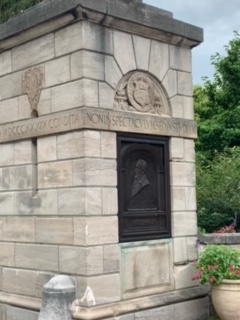
We continued our walk and neared the stone pillars that flank the road leading to the university’s quad with its iconic columns. Ranly stopped again and pointed to the writing on one of the pillars. “Have you seen that before?” 

My husband and I looked at the inscription: NONINSPECTACVLVMSEDINSTVDIVM” We told him that, yes, we had noticed it.

“Ahhh. Usually when I ask people, they haven’t noticed it before. They walk past, but never notice it,” he said. “Do you know what it is?”

Uhhhhh- I struggled. My brain whirled. I cautiously said, “I believe that is Latin.” Oh yes, I had taken some Latin in high school and taught it to my boys; however, that had been years ago. I knew to replace each “V” with a “U”…I remembered that “non” meant “not” and “studium” meant “study,” but I was stumped. I would never become a great Latin scholar. I admitted my defeat.

“It’s from Seneca. Well, actually, the quote should be, ‘In studium non inspetaculum,’” Ranly proudly told us. With that, he was the professor we had known and loved. He shared that Seneca’s quote translates as, “In study not spectacle,” but this inscription actually reads, “Not in spectacle, but in study.” A subtle yet different meaning. With our beloved j-school at one end of the campus and the stadiums at the other, Ranly wished that more people who passed by these pillars would remember to prioritize study above spectacle in their learning pursuits. 

“I often think about who chose to place these words here,” he said. “Wouldn’t that be wonderful to learn!” 

With that momentary lesson, my advisor and mentor reminded me to remain alert and curious, to seek answers to even “little” questions, to share what I know and experience, and most of all to treasure my learning. He reaffirmed my thirst for a life full of learning and educating!

My Years in Detention: It Wasn’t My Fault, I Swear!

There are millions of tips out there on how to fly with kids, what to bring on camping vacations, which suitcase to After 2 years as the in-school detention (ISD) teacher at a middle school and 2 (going on 3) years as the in-school suspension (ISS) teacher at a high school, I have many stories to share. Oh! And I have many tips for setting appropriate boundaries/expectations with students at the onset of each day. This will be a series.